
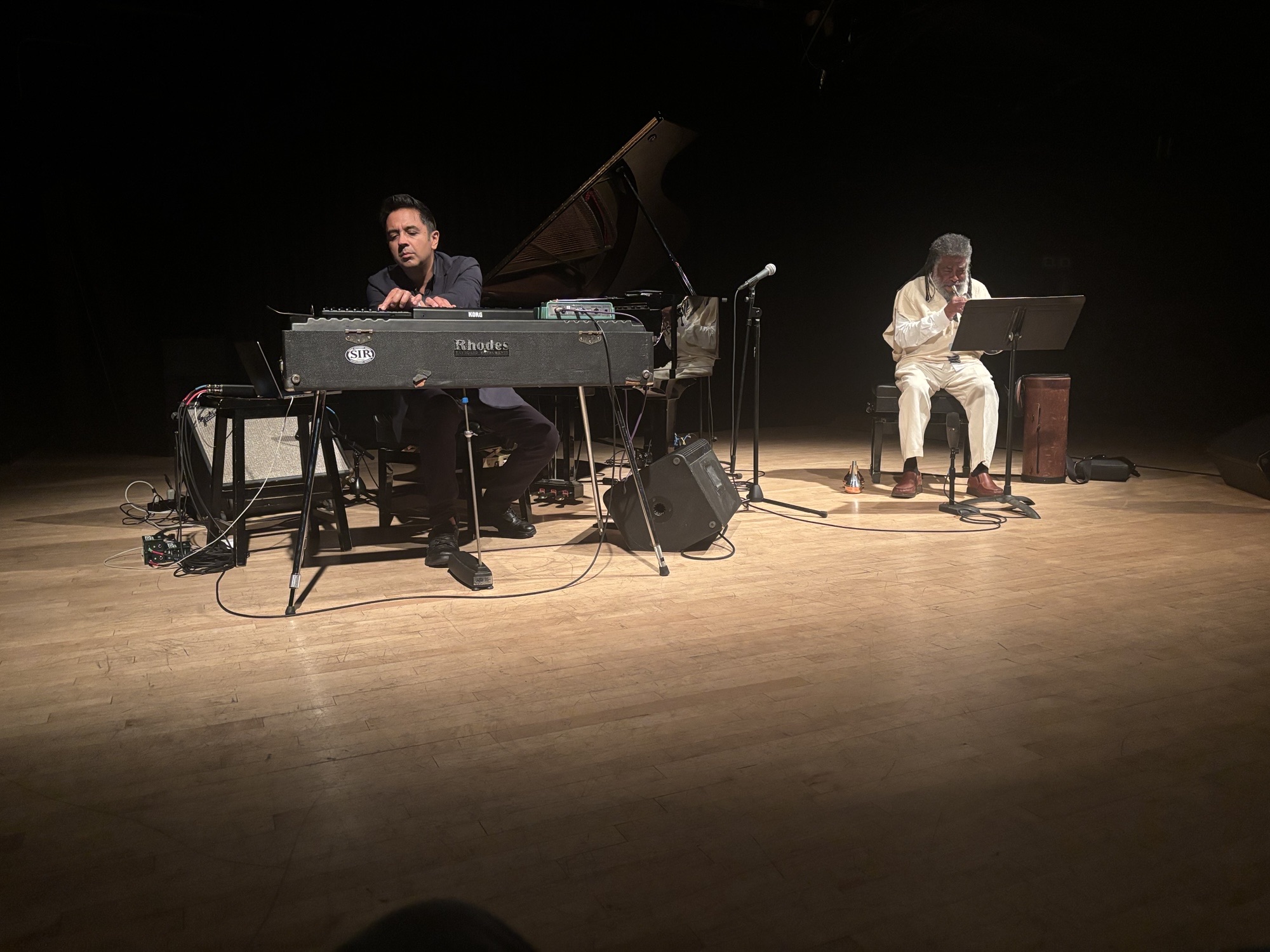
CHICAGO– Friday June 27th at Constellation two titans of forward musical thought Ishmael Wadada Leo Smith- trumpeter composer and Vijay Iyer- pianist and composer graced Chicago with a performance of their second collaboration album “Defiant Life”.
Smith has been a cornerstone of creative music ever since he joined the Association for the Advancement of Creative Musicians in 1967. A true pioneer who has crafted new ways to compose, perform, and improvise. His use of new composition methods not based on western standard notation led to the development of his own composing discipline called “Ahnkramation.” A writing method not focused on tailoring things for only one style at a time but rather creating a musical language that allows for fluidity with which all musicians can navigate to try and connect with themselves and their environment.
Smith, a Pulitzer Prize finalist, has time and time again taken his music and concepts to new heights by bringing creations bursting with his virtuosic gripping sound and ideas.
Iyer is also a musician charged with ideas and musical creation which challenges and drives thought using mathematical sequences to help structure his music. Never has he shied away from truly reforming viewpoints through the theory and approach he uses when writing and performing. Currently teaching at Harvard he continues to help lead the charge in creative music.
Smith and Iyer first worked together in Smith’s Quartet but later came to work together as equal collaborators releasing their first project “A Cosmic Rhythm With Each Stroke” in 2016. For their latest work “Defiant Life” Smith and Iyer have stated in an interview with NPR that the album can be thought of “as a notion of dialogue where you look at the essentials, and you look at the possibilities, and you look at that which is necessary.” When listening and seeing “Defiant Life” be performed live this idea of dialogue blossoms to take your mind and the music into new levels of contemplation, meditation, and actualization.
As both Smith and Iyer sat down it felt as though the room held its breath in anticipation for them to begin. Starting of course with the first track, “Prelude: Survival,” Iyer set the stage with a rich dark texture from the piano. Slowly his volume would rise and fall in a hairpin fashion creating tension for Smith to speak with.
Smith entered with small layers of sound from his horn to accompany Iyer’s growing ideas which started to build out towards small runs in his middle and upper register. Continuing their dialogue, Smith slowly started to incorporate sharper edges in his language before taking a moment for Iyer to play alone. Iyer split his hands between his Grand and Rhodes piano as he slowly moved the audience into almost a dreamlike state with the Rhodes soft tones.
Finally, Iyer reveals his plan as he starts to use one of his other synthesizers to transition into the album’s second track “Sumud” which starts with waves of high pitched frequencies stacked upon one another with a long, drawn out bass tone creating feelings akin to floating in water. On top of this texture Smith creates a prominent line with flows throughout the foreground and background combining strong melodic components and extended techniques to bring out the sound of just his buzzing on the mouthpiece.
Together their conversation shifts to a more direct way of communication with Iyer again on the Rhodes and Smith now pushing out longer periods of speech combined with short shots from his trumpet to build up a varied emotional path. All the while Iyers playing lays down a mixture of consonant beauty, juxtaposed by dissonant ideas of weight. Smith continues this motif with his horn as he starts to quickly run up and down the range of his trumpet before extending to the upper stratosphere of his horn.
Both Smith and Iyer’s speech and ideas intertwined together, drawing the audience into their dialogue of sound. Iyer then again takes the foreground like in the Prelude with a solo, incorporating lines of the jazz idiom and utilizing the reverb of the Rhodes piano to have a canvas on which to paint. Finally, Smith joins Iyer again and both musicians come together in a more reserved fashion which slowly dissipates together before ending with a beautiful chord from Iyer.
The third track “Floating River Requiem” begins with Iyer alone creating a mixture of atmospheres with some truly exquisite voicings on the piano. Pushing feelings of peace mixed with dissonant feeling, Smith was able to sing across the top of this foundation creating another epic of a melody that began as legato tones each one knitted with the next in his story. Slowly both Smith and Iyer came together to build up a mountain of sound gripping the audience in their cascade of notes together before allowing another natural dispersion of the sound into the end of the piece.
As the applause died Smith took the foreground of the fourth track “Elegy: The Pilgrimage.” Utilizing a Harmon mute, Smith was able to again take the use of his sound in a different direction than the last track as he used a series of spaced out melodic ideas, cries, and small bursts of notes. All the while Iyer contributed to this sonic atmosphere with the use of his synthesizers and small use of the piano. Once Iyer did come to the foreground both he and Smith played off each other’s conversation in such a way that still left so much free space for their sound to rest before Iyer wound the track down with a pattern on the lower end of his grand piano. Before starting again with brisk strikes and plunks on his piano while Smith played over top.
Iyer started the penultimate track “Kite (for Refaat Alareer)” on his Rhodes again. Its soft style serves as a striking juxtaposition to the previous vigor, providing a point of difference in the tone and context of this dialogue. Both Iyer and Smith kept their playing in a much softer range here with Iyer using his synths to lay down full low drones as he and Smith seemed to explore this floor of sound. As their playing proceeded Smith, who had started with a Harmon mute took it out and increased his volume with his split up ideas. Iyer started a repetitive rhythmic pattern on his piano which combined with flurries of notes from Smith which made for an experience that drew in one’s full attention.
Before jetting into a revisitation of some previous language from Smith as they wound down this composition. It was here that Smith and Iyer both stood and took a few moments to acknowledge each other as friends, collaborators, and musicians.
Smith gave a few choice words that I felt stuck with me, to paraphrase, he stated that while the world is hard and tumultuous right now, within the space between audience and performing artist,things were ok. That there is a peace which is held within such spaces that cannot be affected by the outside world. In my eyes, I saw it as a beautiful testament to the power of the arts, especially music. Especially in terms of its ability to bring communities together and help heal us.
Once again both musicians sat down for the final track “Procession: Defiant Life,” in this performance it started with precise sporadic playing. Running through the keys by Iyer and blasts of tightly knit notes by Smith, it raised one’s adrenaline while seeing the performance. After a few minutes Smith and Iyer transitioned into a grander wider playing style with Smith expounding a beautifully rich melody as Iyer raised around him a tapestry of sound. One final time they both wound down. First Smith slowed to a stop, leaving Iyer alone to slowly take the track to rest. Finally, both stood to bow after this remarkable performance, two legends sharing their fabulous creation with us.
I highly recommend diving deeper into both Smith and Iyers catalogues as they are filled with amazing work. I suggest trying to catch any of their upcoming performances as they exhibit such amazing musicianship and artistic ability. Both Iyer and Smith truly harness energy you can rarely be in the vicinity of let alone observe in performance. Two titans of the music unlike any others.
###